
What is Kniffel?
Kniffel is one of the most popular dice games of all — and one of the easiest to pick up. All you need are 5 dice, a cup and a score card with 13 boxes. On each turn you get up to 3 rolls to build the most valuable combination you can: lots of the same number, a full house, a straight or, with a little luck, five of a kind — the famous Kniffel itself.
What makes it compelling is the mix of luck and decisions. Which dice do you keep, which do you roll again? Do you settle for a so-so result now or push your luck? And which box do you sacrifice when nothing fits? Because each of the 13 boxes can be filled only once, every choice echoes until the very end of the game.
In English-speaking countries the game is best known as Yahtzee, while Kniffel is the name German players grew up with. The core rules are identical; the variants only differ in how five of a kind is treated once the Kniffel box is already filled. You can play both here.
How to play Kniffel here
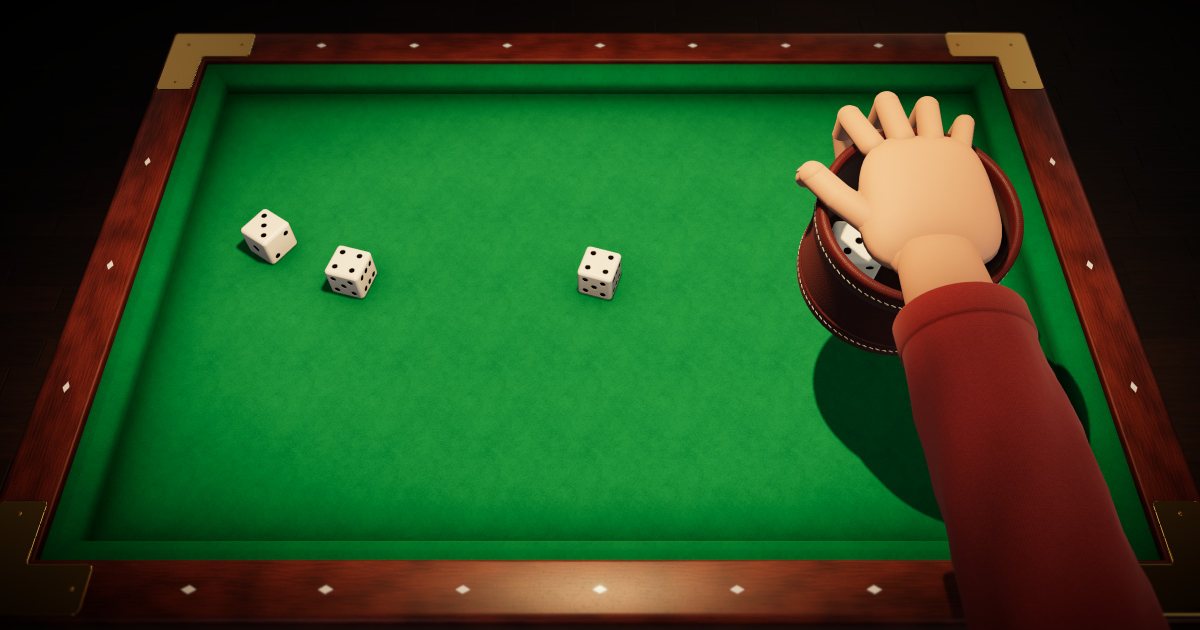
Our Kniffel feels like a real table: the dice tumble across the felt with simulated physics, bounce off the cushions and stay where they land.
Shake the cup
Press and hold the cup with your mouse or finger and move it around — you will hear the dice rattle. Let go and they fly onto the table. You can also roll with the “Roll” button or the space bar.
Keep your dice
After a roll all dice stay on the table. Tap the ones you want to roll again and they go back into the cup; tap a die in the cup to put it back in its place. You have 3 rolls per turn.
Score a box
The score card shows how many points your dice would earn in every open box. Pick one — or scratch a box for 0 points when nothing fits. Then it is the next player’s turn.
In the start menu you set up your table: up to 6 seats, any mix of people and bots (easy, normal or hard). Several people can take turns on one device. A game in progress is saved in your browser automatically, so you can pick it up again later.
To play with friends on their own devices, create a lobby and share the invite link. Everyone watches the cup being shaken and the dice rolling live, and you can fill empty seats with bots.
On a computer, keyboard shortcuts help: space rolls, keys 1 to 5 select dice, S pins the score card. On a phone you can turn on shake-to-roll in the settings, and on Android devices vibration feedback as well. Graphics quality, dice style (classic, casino or onyx) and sound are adjustable as well.
Kniffel rules
The rules fit on a beer mat — the finer points live in the boxes of the score card.
Goal and flow of the game
A game lasts 13 rounds, one for each box on the score card. Players take turns, one turn per round each. You play with 5 ordinary six-sided dice, and the highest total after the last round wins.
A turn
Roll all 5 dice. Then keep as many as you like and roll the rest again — up to 3 rolls in total. Dice you kept earlier may join the next roll again. You do not have to use every roll: if you are happy, score right away.
Scoring and scratching
At the end of your turn you fill exactly one open box. If your dice do not meet its condition, you score 0 there — the box is scratched. A filled box can never be changed, not even with a better roll later on.
Upper section and bonus
In the boxes Ones to Sixes only dice showing that number count: three fours in the “Fours” box score 12, the rest of the roll is ignored. If your upper section adds up to at least 63 points, you earn a 35-point bonus on top.
63 points is exactly three dice of every number (3 × 1 + 3 × 2 + … + 3 × 6). Score four of a high number and you can afford a gap among the low ones.
Lower section
The lower section rewards combinations. Some are worth fixed points, others the sum of all five dice:
- Three of a Kind: at least three dice the same — sum of all dice.
- Four of a Kind: at least four dice the same — sum of all dice.
- Full House: three of one number plus two of another — 25 points.
- Small Straight: four consecutive numbers, e.g. 2-3-4-5 — 30 points.
- Large Straight: five consecutive numbers (1-2-3-4-5 or 2-3-4-5-6) — 40 points.
- Kniffel: five of a kind — 50 points (called “Yahtzee” under the official rules).
- Chance: any roll — sum of all dice.
End of the game
After 13 rounds every box is filled. Your total is the upper section including the bonus plus the lower section — and, under the Yahtzee rules, any bonus points for extra five-of-a-kinds. The highest total wins; tied players share the place.
Score table
All 13 boxes at a glance — with condition, example roll and points.
| Box | Condition & example | Points |
|---|---|---|
| Upper section | ||
| Ones | Count all ones= 3 | 0–5 |
| Twos | Count all twos= 4 | 0–10 |
| Threes | Count all threes= 12 | 0–15 |
| Fours | Count all fours= 12 | 0–20 |
| Fives | Count all fives= 10 | 0–25 |
| Sixes | Count all sixes= 24 | 0–30 |
| Bonus | Upper section worth at least 63 points | 35 |
| Lower section | ||
| Three of a Kind | At least three the same, sum of all dice= 19 | 5–30 |
| Four of a Kind | At least four the same, sum of all dice= 27 | 5–30 |
| Full House | Three of one number and two of another | 25 |
| Small Straight | Four consecutive numbers | 30 |
| Large Straight | Five consecutive numbers | 40 |
| Kniffel | Five of a kind | 50 |
| Chance | Any roll, sum of all dice= 21 | 5–30 |
| Yahtzee bonus | Yahtzee rules only: every further five of a kind while the Kniffel box holds 50 points | +100 |
Advertisement
Kniffel and Yahtzee rules compared
You choose the rule variant before each game. The differences only matter when you roll five of a kind while the Kniffel box is already filled — with 50 points or scratched.
Variant “Kniffel” (classic rules)
Five of a kind scores 50 points in the Kniffel box. If you roll another one later, there is no extra bonus: you score it like any other roll in an open box of your choice — as Three or Four of a Kind, Chance or in the matching upper box.
It does not count as a Full House or a straight, because five equal dice do not meet those conditions.
Variant “Yahtzee” (official Hasbro rules)
Here every further five of a kind pays off twice: if the Kniffel box already holds 50, each additional one earns a 100-point bonus. If you scratched that box, there is no bonus — but the joker rule still applies.
Under the joker rule a further five of a kind must be scored in a fixed order:
- If the matching upper box is still open — “Fours” for five fours — you must score it there.
- If that box is taken, pick any open box in the lower section. Full House, Small and Large Straight then count as jokers worth the full 25, 30 and 40 points.
- If the lower section is full as well, you scratch an open upper box for 0 points.
| Rule | Kniffel | Yahtzee |
|---|---|---|
| First five of a kind in the Kniffel box | 50 points | 50 points |
| Every further five of a kind | no bonus | +100 points if the box holds 50 |
| Joker rule | no, free choice of box | yes, fixed order |
| Five of a kind as Full House or straight | no | yes, as a joker |
| Highest possible total | 375 points | 1,575 points |
Tips & strategy
Luck decides a single roll, strategy decides the game. These principles will lift your average score noticeably.
Plan for the bonus
The 35 bonus points in the upper section are the foundation of a good score. Rule of thumb: three dice of every number make exactly 63. Keep track of whether you are above or below that par — four sixes are 6 points over and make up for being two threes short.
That is why it pays to go for four or five of a high number in the early rounds and score them up top. Ones and twos, on the other hand, are little more than padding: even five ones are worth just 5 points.
When to chase a Kniffel
Five of a kind in a single throw is rare: the odds are 1 in 1,296. Over three rolls, always keeping the most frequent number, they rise to about 4.6 percent per turn. With four of a kind after the first roll and two rolls left you have roughly a 31 percent chance; with three of a kind about 9 percent.
So three of a kind is a good reason to give it a go — especially since the roll stays useful if the Kniffel does not come: as Three or Four of a Kind or in the upper section.
Play straights the smart way
Straights need different numbers, not equal ones. A run from the middle like 3-4-5 is worth more than 1-2-3 because it can grow in both directions. With an open run of four such as 2-3-4-5 and two rolls left, you complete the Large Straight a little over 55 percent of the time; with a one-sided run like 1-2-3-4 only about 31 percent.
Once you hold a Small Straight, keep it and roll the fifth die for the Large one. If it misses, the Small Straight is still safe — the re-rolled die cannot break it.
Full House: take it when it comes
A Full House is always worth 25 points, whatever the numbers. Waiting rarely pays: if one lies on the table and the box is open, scoring it is almost always right.
Two pairs are a good starting point: with two rolls left they turn into a Full House a little over half the time — and if you are going for a three of a kind you often land there along the way.
Use Chance and scratches wisely
Chance is your safety net for a failed roll with a high sum. Do not waste it early on 15 points; save it for rolls of about 22 or more.
When you have to scratch, pick the box that costs you least. Early on that is usually Ones, which can never be worth more than 5 points. Late in the game the Kniffel box is often the cheapest sacrifice: with only a few rounds left, five of a kind is unlikely anyway.
Read the scoreboard
Against other players the goal is winning, not the highest possible score. Ahead near the end? Play the safe boxes. Behind? Take risks and go for the Kniffel or the Large Straight.
For perspective: even with perfect strategy the average is about 245 to 255 points, depending on the rule variant — anything over 200 is a really good result. The bots make great sparring partners: on “easy” they follow rules of thumb and slip up now and then, on “normal” they plan one roll ahead, and on “hard” they calculate every turn exactly.
Advertisement
Kniffel FAQ
Can I play Kniffel here for free?
Yes. Kniffel on Regulars is completely free — no sign-up, no download and no in-app purchases. All you need is an up-to-date browser.
How do I play Kniffel online with friends?
Click “Play with friends”, choose a nickname and create a lobby. Copy the invite link, share it from your phone or show the QR code. Whoever opens it joins your table — up to 6 players per game, further guests can watch. The host can fill empty seats with bots.
Can I play on my own?
Of course. Play solo to chase a high score or challenge up to 5 bots on easy, normal or hard.
Does Kniffel work on phones and tablets?
Yes. The game is made for touch screens: shake the cup with your finger, tap dice, pick a box. If you like, roll by shaking your phone; on Android devices you can also feel the dice through vibration. On older devices, a lower graphics quality in the settings helps.
How many people can play?
1 to 6 players per game, any mix of people and bots. On one device you take turns; online everyone plays on their own device.
What is the difference between Kniffel and Yahtzee?
The core rules are the same. Under the official Yahtzee rules every further five of a kind earns 100 bonus points while the Kniffel box holds 50. On top of that, the joker rule applies as soon as the Kniffel box is filled — even if you scratched it. The classic Kniffel variant has neither. See the rules comparison for details.
What if my roll does not fit any box?
Then you have to scratch a box, i.e. fill it with 0 points. The cheapest choice is usually a box with little potential, such as Ones.
What is the highest possible score?
Under the Kniffel rules 375: five of a kind in every upper box plus the bonus, and the maximum in every lower box. Under the Yahtzee rules up to 12 bonus five-of-a-kinds worth 100 points each can be added in theory — 1,575 points in total.
How likely is a Kniffel?
In a single throw of all five dice the odds are 1 in 1,296. Using all three rolls and always keeping the most frequent number, you get five of a kind in about 4.6 percent of turns.
Is my game saved?
Yes, games on a single device are saved in your browser automatically. Close the page and continue later with “Continue”. No data is sent to us for this.